You Won’t Believe What’s Hiding in Ashgabat’s Business District
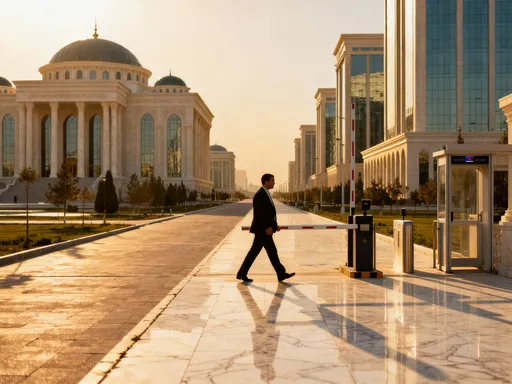
Ashgabat, the marble-clad capital of Turkmenistan, is often overlooked by travelers. But beyond its surreal monuments lies a quiet pulse: its business district. Far from typical tourist trails, this zone blends modern ambition with Soviet echoes. I walked its wide boulevards under golden domes, sipping tea in a sleek café near government offices, watching locals in sharp suits pass by. It’s unexpected, orderly, and strangely fascinating—where commerce meets quiet control, and every building tells a story of a nation trying to redefine itself.
First Impressions: Walking Into a Marble Dream
Stepping into Ashgabat’s central business district feels like entering a city suspended in time—a place where urban planning meets political vision on a grand scale. The first thing that strikes any visitor is the sheer dominance of white marble. Reflecting the intense Central Asian sun, the facades of government buildings, banks, and administrative centers shimmer in hues of pearl and ivory. Wide, tree-lined avenues stretch uninterrupted for kilometers, flanked by manicured lawns and ornamental fountains that rarely run. The sense of order is absolute, almost unnerving. There are no billboards, no graffiti, no chaotic street markets—only silence, symmetry, and an eerie cleanliness that feels more curated than lived-in.
Yet beneath this polished surface, subtle signs of economic activity persist. Uniformed security personnel stand at attention outside glass-encased entrances, nodding as officials in dark suits pass through. Delivery motorbikes weave discreetly through side streets, dropping off documents or supplies to back entrances. These moments break the stillness, reminding the observer that this is not a museum exhibit but a functioning urban center. The city’s unique aesthetic is no accident. After the devastating 1948 earthquake destroyed much of old Ashgabat, the Soviet government rebuilt it with wide streets designed to prevent fire from spreading—a layout that now serves another purpose: control. Today’s reconstruction, led by post-independence leadership, has doubled down on scale and symbolism, transforming the capital into a stage for national pride.
The result is a business district that feels both futuristic and frozen. Pedestrian traffic is sparse. There are no spontaneous encounters, no street musicians, no pop-up vendors. What little commerce exists at ground level is tightly regulated. A kiosk might sell bottled water or SIM cards, but only in designated zones. The absence of informal trade is striking, especially compared to neighboring capitals like Tashkent or Dushanbe, where bazaars spill into sidewalks. Here, everything is contained, calculated. The message is clear: Ashgabat is not built for wandering. It is built for purpose.
The Heart of Commerce: Where Business Happens Quietly
If one were to pinpoint the economic core of Ashgabat, it would center on Magtymguly Avenue—the city’s main thoroughfare—and the newer developments near the International Business Center. These areas house the headquarters of state-owned enterprises, national banks, and key regulatory bodies. Turkmenistan’s economy is heavily centralized, and this is where decisions are made, deals are brokered, and policies take shape. The Central Bank of Turkmenistan, with its neoclassical columns and gold-trimmed dome, stands as a monument to financial authority, though its operations remain opaque to outsiders.
Among the most visible players in the business landscape are the state-controlled telecommunications providers, such as Altyn Asyr, whose logo appears on sleek office towers and official vehicles. These companies serve as both service providers and instruments of national policy, managing internet access and mobile networks under strict oversight. While private mobile operators exist elsewhere in the region, in Turkmenistan, the sector remains firmly in government hands. That said, there are signs of cautious international engagement. A few foreign-linked service offices—often tied to construction, energy consultancy, or logistics—operate within secure compounds, their presence signaled by discreet signage in Cyrillic and English.
Yet real commerce in Ashgabat rarely unfolds in public. Business is conducted behind closed doors, in meetings that require connections, permissions, and layers of protocol. Foreign investors face significant barriers, including visa restrictions, currency controls, and limited legal transparency. While Turkmenistan possesses vast natural gas reserves—one of the largest in the world—access to its markets is tightly managed. International companies involved in infrastructure projects often work through joint ventures with state partners, navigating a complex web of approvals. The result is an economy that appears modern on the surface but remains insular in practice. For the casual observer, the business district offers more questions than answers—its glass towers reflecting not just sunlight, but also the opacity of power.
Architecture as Power: Buildings That Speak Volumes
In Ashgabat, architecture is not merely functional—it is a language of authority. Every column, dome, and facade carries meaning, projecting strength, stability, and sovereignty. The Turkmenistan Tower, rising over 200 meters with its illuminated crown, serves as both a telecommunications hub and a national symbol, visible from miles away. Similarly, the Ministry of Oil and Gas building, with its grand staircase and marble colonnades, resembles a temple dedicated to the country’s most valuable resource. These structures do not whisper; they declare.
The architectural style is best described as controlled modernity—neither the flamboyant excess of Dubai nor the utilitarian pragmatism of Soviet-era planning, but a deliberate fusion of both. Classical elements like pediments and porticos are paired with futuristic glass curtain walls and metallic finishes. Gold leaf accents are common, particularly on state buildings, reinforcing a sense of grandeur and permanence. This aesthetic choice is not accidental. It reflects a national narrative of rebirth and resilience, positioning Turkmenistan as a sovereign player on the world stage, even as it remains largely closed to outside influence.
One of the most telling features of Ashgabat’s business district is the near-total absence of advertising. Unlike most global cities where corporate logos dominate the skyline, here the visual space is reserved for state messages. Occasional banners promote national holidays or government initiatives, but commercial branding is virtually nonexistent. This scarcity reinforces the idea that the economy is not driven by consumerism or competition, but by centralized direction. Even the few international companies operating in the city must adapt to this environment, often blending into the background rather than standing out.
The result is a cityscape that feels more like a curated exhibition than a living metropolis. Buildings are not just workplaces—they are monuments to ideology. Walking through the district, one cannot help but feel the weight of intention behind every design decision. This is urban planning as performance, where form follows not function, but narrative. For visitors, the experience is both awe-inspiring and unsettling—a reminder that in some places, architecture is less about shelter and more about statement.
Daily Rhythms: A Day in the Life of a Business Quarter
The rhythm of Ashgabat’s business district unfolds with quiet precision. Mornings begin early, marked by the arrival of government employees and administrative staff. Security checkpoints at major buildings buzz with activity as IDs are scanned and vehicles inspected. Uniformed guards stand at attention, their presence a constant reminder of order and protocol. By 9 a.m., the sidewalks see a steady but measured flow of professionals—men and women in modest, conservative attire, often carrying leather briefcases or government-issued folders. There is no rush, no jostling. The pace is deliberate, almost ceremonial.
Lunchtime brings a subtle shift. A few cafes near ministry buildings see a modest influx of workers, sipping tea or eating simple meals of plov or manty. These establishments are clean, quiet, and strictly regulated—no loud music, no lingering patrons. Outside, kiosks sell bottled water, packaged snacks, and prepaid mobile cards, catering to the needs of office workers without disrupting the aesthetic order. There are no food trucks, no sidewalk seating, no casual encounters. The concept of a “coffee run” exists, but it is stripped of informality. Even the act of buying a sandwich feels institutionalized.
Transportation patterns reinforce the district’s controlled atmosphere. Government motorcades, marked by flashing lights and dark-tinted sedans, move through designated lanes with little interference. Private vehicles are rare—ownership is expensive, fuel is subsidized but limited, and parking is tightly managed. Public transit exists, but buses and the city’s sleek metro system serve the outskirts more than the center. Taxis operate, but mostly through pre-arranged services rather than street hails. The absence of ride-sharing apps or digital booking platforms underscores the limited role of technology in daily life.
Perhaps most striking is what is missing: the buzz of startups, the energy of coworking spaces, the visible signs of entrepreneurial hustle. There are no tech hubs, no innovation centers, no visible private enterprises beyond small, state-approved shops. The business district does not encourage spontaneity. It rewards adherence to routine. Every movement, every transaction, every interaction seems choreographed—not by force, but by culture, habit, and structure. To walk through it is to witness a system in balance, where predictability is not a flaw, but a feature.
Hidden Interactions: Where Locals and Economy Meet
Beneath the surface of Ashgabat’s pristine business district, another economy thrives—one defined by discretion, trust, and cash. While the official sector operates within sealed offices and state institutions, informal exchanges occur in the margins. Hotel lobbies, particularly in the few international-standard accommodations, become quiet hubs for currency exchange. Travelers seeking Turkmen manat may find discreet offers from individuals who move with practiced subtlety, exchanging dollars or euros at rates slightly better than official counters. These transactions are unrecorded, unregulated, and essential for those navigating a system where banking access is limited.
Near embassy compounds and diplomatic zones, brief conversations unfold between locals and foreign staff—negotiations for services, translations, or transportation. These interactions often lead to small-scale business arrangements, facilitated by personal connections rather than contracts. Similarly, in the side alleys just beyond the main avenues, vendors sell mobile SIM cards, power adapters, or local SIM registration services. These are not open markets, but fleeting exchanges, conducted quickly and quietly, aware of the watchful presence of authorities.
For a fuller picture of Turkmenistan’s economic life, one must look beyond the city center. On Ashgabat’s outskirts, the Tolkuchka Bazaar—officially known as the Gumbaz Market—bursts with activity. Here, farmers, artisans, and traders gather daily, selling everything from fresh produce to handmade textiles. Unlike the sanitized center, this space is loud, crowded, and alive with negotiation. It is also where much of the country’s informal economy operates, with cash changing hands for goods and services outside the formal tax system. The contrast between Tolkuchka and the business district could not be starker: one is vibrant and organic, the other polished and controlled.
Across both spaces, cash remains king. Credit cards are rarely accepted, digital payment platforms like mobile banking or e-wallets are underdeveloped, and internet access is restricted. Trust, not technology, governs transactions. A handshake, a familiar face, a word from a mutual contact—these are the currencies of commerce. In a country where transparency is limited and institutions are centralized, personal relationships become the foundation of economic life. To understand Ashgabat’s business culture, one must learn to read not just the buildings, but the silences between them.
Challenges and Contradictions: Growth Behind Closed Doors
Turkmenistan’s economic landscape is shaped by both potential and constraint. The country sits atop the fourth-largest natural gas reserves in the world, giving it significant resource wealth. In theory, this should fuel robust growth, diversification, and international integration. In practice, the economy remains highly insulated. Trade is concentrated among a few partners—China, Russia, and Iran—with limited openness to broader markets. The national currency, the manat, has faced periods of instability, and access to foreign exchange is tightly controlled. These conditions create challenges for both domestic enterprise and foreign engagement.
While Ashgabat’s infrastructure impresses with its scale and ambition, actual market dynamism is restrained. Private enterprise exists, but on a small scale and often within sectors approved by the state. Bureaucratic hurdles, unclear regulations, and limited access to financing make it difficult for entrepreneurs to expand. Reports from international financial institutions note that while the government invests heavily in construction and public works, the private sector contributes a relatively small share of GDP. Innovation is rare, competition is limited, and consumer choice is narrow.
Foreign investors, even those with experience in Central Asia, often find the environment challenging. Legal frameworks are not always transparent, dispute resolution can be slow, and political risk remains a concern. While certain sectors—such as construction, energy services, and telecommunications—offer opportunities, they require navigating a complex landscape of approvals and partnerships. The government promotes foreign investment through special economic zones and incentives, but implementation is inconsistent. As a result, many international companies proceed with caution, limiting their presence to short-term contracts or joint ventures.
These contradictions define Ashgabat’s business district: a place of striking modernity that functions within a system resistant to change. The buildings are new, the streets are clean, the vision is clear—but the mechanisms of a dynamic market economy are still developing. Growth is visible in concrete and steel, but less so in opportunity, competition, or openness. For now, the city’s economic pulse remains steady, quiet, and carefully managed.
Why This Matters: Ashgabat’s Quiet Message to the World
The business district of Ashgabat is more than a collection of offices and ministries—it is a mirror held up to Turkmenistan’s identity. Closed, proud, selectively modern, it reflects a nation that chooses its pace, its partners, and its image with deliberate care. To walk through its marble-lined avenues is to witness a different model of development—one where stability and sovereignty take precedence over openness and disruption. In an age of hyperconnectivity and global integration, Ashgabat stands apart, not by accident, but by design.
Understanding this space offers more than travel insight; it provides a lens into how isolated nations project strength. The absence of chaos is not a flaw—it is a statement. The dominance of state architecture, the scarcity of advertising, the quiet streets—all speak to a worldview in which control is synonymous with order, and order is the foundation of progress. For travelers, the lesson is clear: not all cities reveal themselves through noise. Some speak in silence, in symmetry, in the weight of a marble column under a desert sun.
This does not mean Ashgabat should be judged solely by Western economic standards. Its success cannot be measured only in GDP growth or startup valuations. Instead, it invites a different kind of observation—one rooted in curiosity, patience, and respect for context. To visit is not to consume, but to interpret. Every building, every uniformed guard, every quiet transaction carries meaning. The city does not shout; it signals.
For the thoughtful traveler—particularly those who seek depth beyond the postcard view—Ashgabat’s business district offers a rare opportunity. It challenges assumptions about what a capital city should look like, how an economy should behave, and what progress means in different cultural contexts. It reminds us that behind every skyline is a story of choices, values, and visions. So go with open eyes. Walk the wide boulevards. Sip tea in a quiet café. Watch the suited figures pass by. And let the silence tell its own tale—one of ambition, control, and a nation writing its future, one marble block at a time.